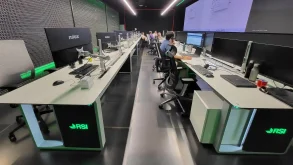
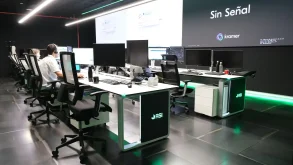
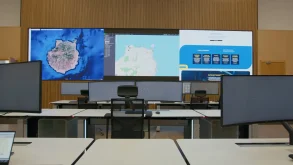
Professionals working in the field of infrastructure construction often find that different spaces have specific needs. For example, an emergency room has very different needs than an office and a surgery room is not designed the same way as a garage. All of these spaces have specific requirements derived from their nature with specific structural, environmental or safety requirements.

And the control rooms could not be any other way. They are not simply offices with many screens, but they are the core from which larger and more complex systems such as industrial processes, transportation systems or security systems, among many others, are controlled. They are critical environments in which very complex operations are carried out and in which the tolerance for error is very low.
In these rooms, operators and supervisors are subjected to very high demands and as a consequence the need arises to align the architectural design with the technician to enhance their performance.

Considering what specific needs a control room may have, we find the integration of complex technological equipment, the coordination between maintenance and operational tasks, special security situations, system redundancy or support for the performance of operators. And if we focus on the performance of workers, we find concepts such as Visual Fatigue, Thermal Comfort or Air Quality among others, grouping these factors into what we know as Ergonomic Needs.
There are several standards that can guide us when finding a way to meet the ergonomic needs in a control room. For example, the ISO 11064 series on Ergonomic Design of Control Rooms, ISO 9241 related to Working with Screens, UNE-EN 527 that deals with Work Tables, ISO 14738 that talks about Anthropometric Requirements or ISO 10075 that deals with Mental Load.
To guarantee that we comply with the ergonomic needs that exist in a control room, the first step will always be to rely on the ISO 11064 standard, since it establishes a methodological framework focused specifically on the ergonomic needs of this type of environment. This standard is divided into seven parts:
ISO 11064-1: Principles for the design of control centers
Establishes the general framework for the ergonomic design of control centers. It defines the principles of human-centered design and structures the process in different phases, from the clarification of objectives to the final validation of the design, helping to integrate ergonomics within the overall project process and ensuring that technical, organizational and spatial decisions are aligned with it.
ISO 11064-2: Arrangement of the set of rooms
It addresses the functional organization of the set of spaces that make up the control center, composed of control rooms and support areas.

ISO 11064-3: Control room layout
Dedicated to the internal configuration of the control room, location of positions, shared lines of sight, circulation, proximity between operators and supervision requirements.
ISO 11064-4: Size and layout of workstations
It develops ergonomic criteria related to the design of the checkpoint itself. It addresses aspects such as the size of the work area, scope, layout of screens and controls, integration of equipment and adaptation to different users to guarantee that the physical configuration of the position is adapted to the anthropometry of its user and the functions performed therein.
ISO 11064-5: Displays and controls
It addresses the design of interfaces, screens and control devices, establishing principles on information organization, visual consistency, alarm hierarchy and interaction logic.
ISO 11064-6: Environmental requirements
Helps manage lighting, acoustics, temperature or air quality needs so they do not negatively affect performance.
ISO 11064-7: Control center evaluation and validation
Guide in creating a system to analyze compliance with the ergonomic objectives of the project.

We must keep in mind that although the ISO 11064 standard may define specific parameters, it is far from being a catalog of pre-designed solutions that are applied generically. Mainly, it is a methodological framework with criteria and principles that, when applied iteratively to a project, help develop solutions aligned with meeting the ergonomic needs of each project.
At this point, some doubts arise: how far does the application of ISO 11064 go? Is it necessary to go beyond this scope? What tools do we have to help us in its application? In order to answer these questions, we are going to analyze a more specific area of the standard, ISO 11064-4.