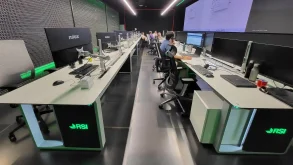
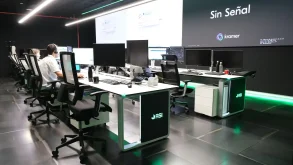
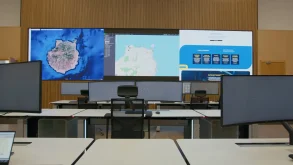
Acoustic comfort in control room design plays a crucial role in operators’ decision-making, as it improves the workspace, increasing the well-being and productivity of users. In a control room, where constant concentration and critical decision making are essential, proper management of sound reverberation not only improves communication between users, but also reduces stress and listening fatigue.
In this article, we will explore what sound reverberation is and its impact on users, what acoustic comfort is and its benefits, and how to implement acoustic solutions in control room and critical environment projects. In addition, we will develop a practical example to acoustically adapt a meeting room.
What is sound reverberation and its impact on users
Reverberation time (T or TR60) is the acoustic phenomenon that is produced by the reflection or rebound of sound in a space. Technically, it measures the time it takes for the sound to decay 60DB after the interruption of its transmitting source.

In the design of control rooms and critical environments, this environmental factor is key to achieving optimal levels of acoustic comfort. A high reverberation time can have repercussions for operators, such as:
- Difficulty for communication understanding.
- Auditory and mental fatigue.
- Increased stress and irritability.
- Risk of confusion of alarms or signals.
- Decreased quality of decision making.
Given that critical decisions are made in control rooms, it is essential to eliminate those environmental factors that compromise their quality. For this reason, in our designs we incorporate sound-absorbing materials on walls, ceilings and consoles that reduce the acoustic reverberation time of the room and guarantee an ideal acoustic environment.
Applicable regulations
To guarantee a space with optimal acoustic qualities, we design our projects in compliance with current regulations, in this case UNE-EN-ISO 11064-6 “Ergonomic design of control centers” in part 6 on “Environmental requirements for control centers.”, which sets reverberation times between 0.4 and 0.75 seconds.
Likewise, the Technical Building Code (TBC) includes a specific section in the BD-PN (Basic Document for Protection against Noise) with limit values for reverberation time, depending on the use of the space and its characteristics, in a range between 0.9 and 0.5 seconds.

Taking these standards as a reference, the team has decided that the appropriate reverberation time for our spaces is between 0.4 and 0.70 seconds.
Acoustic comfort and its benefits in operational spaces
When we design a control room, in addition to lighting, temperature and ergonomics, acoustic comfort is one of the most influential aspects on the health and performance of operators. In short, acoustic comfort refers to the ability of interior spaces to guarantee a pleasant sound field with controlled reverberation levels.
An environment with good acoustic quality contributes to the physical and mental well-being of operators, as it reduces auditory stress and prevents health problems associated with continuous exposure to excessive noise levels, such as auditory fatigue and even cardiovascular problems. These benefits are directly reflected in a greater ability to concentrate, increasing productivity and efficiency in the execution of critical tasks.
Solutions to reduce reverberation time and achieve optimal levels of acoustic comfort in control rooms
To reduce reverberation time and achieve optimal levels of acoustic comfort in control rooms, both the mitigation of external noise and the management of reverberation and internal noise must be considered. To achieve this, at GESAB we propose the acoustic solution for each space based on the following criteria:
- Evaluation of reverberation time.
- Sound absorption and diffusion.
- Selection of materials and percentage of area to cover.
Practical case. Calculation of reverberation time
To determine if a design respects reverberation times, from the GESAB architectural consulting area we have developed a calculation tool that allows us to obtain a first estimated evaluation of the proposed solution. To do this, considering different variables such as the dimensions of the space, the interaction of the surfaces and the absorption coefficients of the proposed finishes, we obtain a comparison of the final reverberation time with the recommended reverberation time according to each case.
The importance of this tool lies in its ability to offer fast and accurate analyzes that not only accelerate the design process, but also allow us to visualize the impact of our decisions in real time by simulating different acoustic scenarios with high precision.
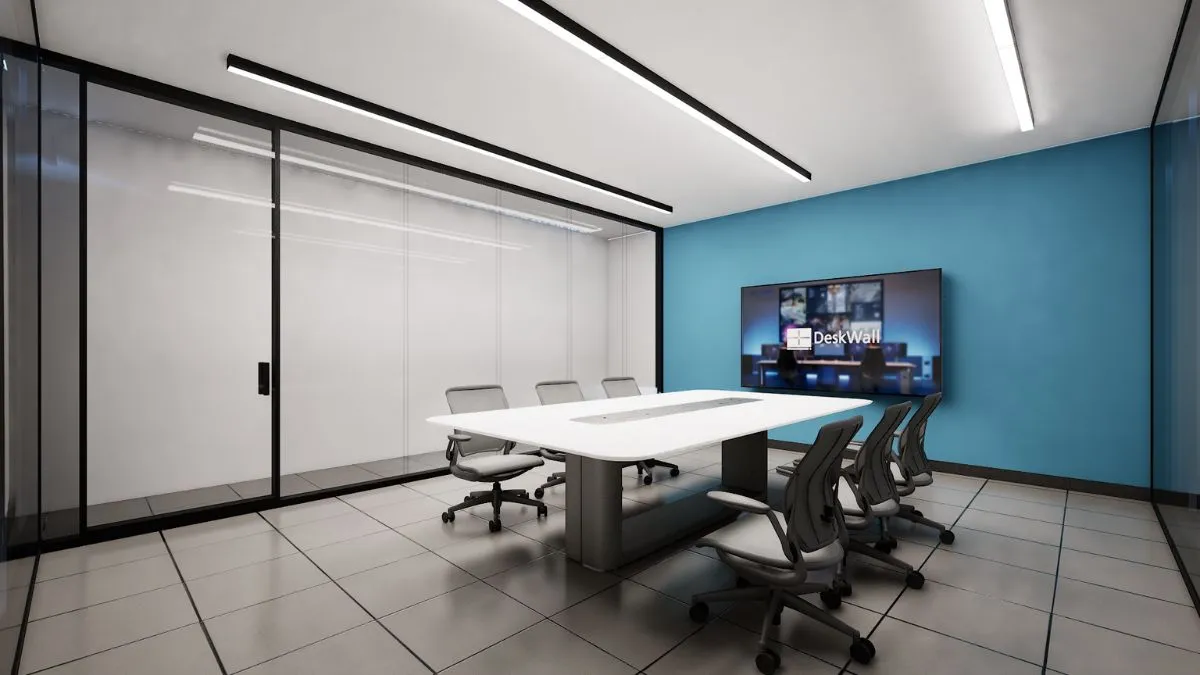
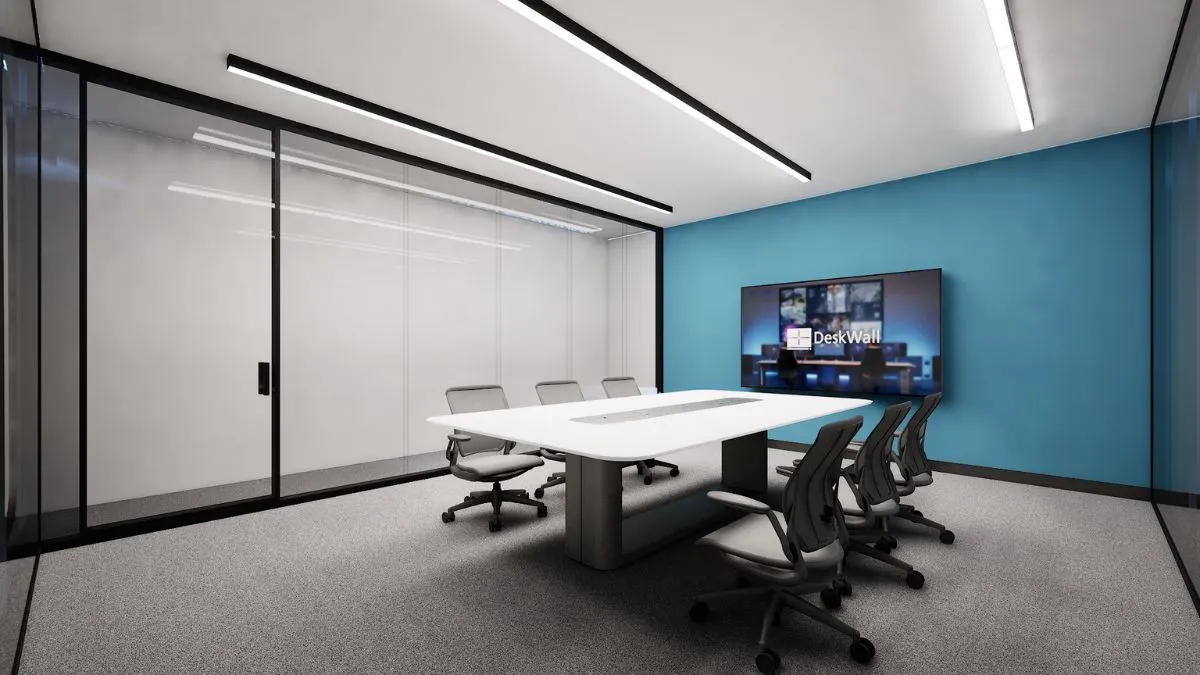
Below are three scenarios where you can see how the choice of coatings impacts the final reverberation time. The space for the example is a typical meeting room, composed of a glass enclosure of screens that delimit a surface of 25.65m2, 2.80m high and a total volume of 72m3. In each example, different coating proposals are simulated, analyzing how they affect the final TR.
Example 1 – Without sound-absorbing materials
Initial proposal with materials with a low absorption coefficient and very acoustically reflective, which causes a very high reverberation time.
- Floor: Porcelain.
- Ceiling: PYL accessible false ceiling (laminated plasterboard).
- Walls: Glass (80%) and PYL (20%).
The final reverberation time is 3.28s, which is far from the recommended levels (0.70 – 0.4s).
Example 2 – Minimum sound-absorbing surface
To optimize the proposal, a final carpet covering is incorporated into the floor, generating a large acoustic absorption surface.
- Floor: Carpet.
- Ceiling: PYL recordable false ceiling (laminated plasterboard).
- Walls: Glass (80%) and PYL (20%).
As a result, we obtain an average final reverberation time of 0.96s which, although it improves the acoustic qualities of the room, does not yet reach the desired values.
Example 3 – Complete intervention
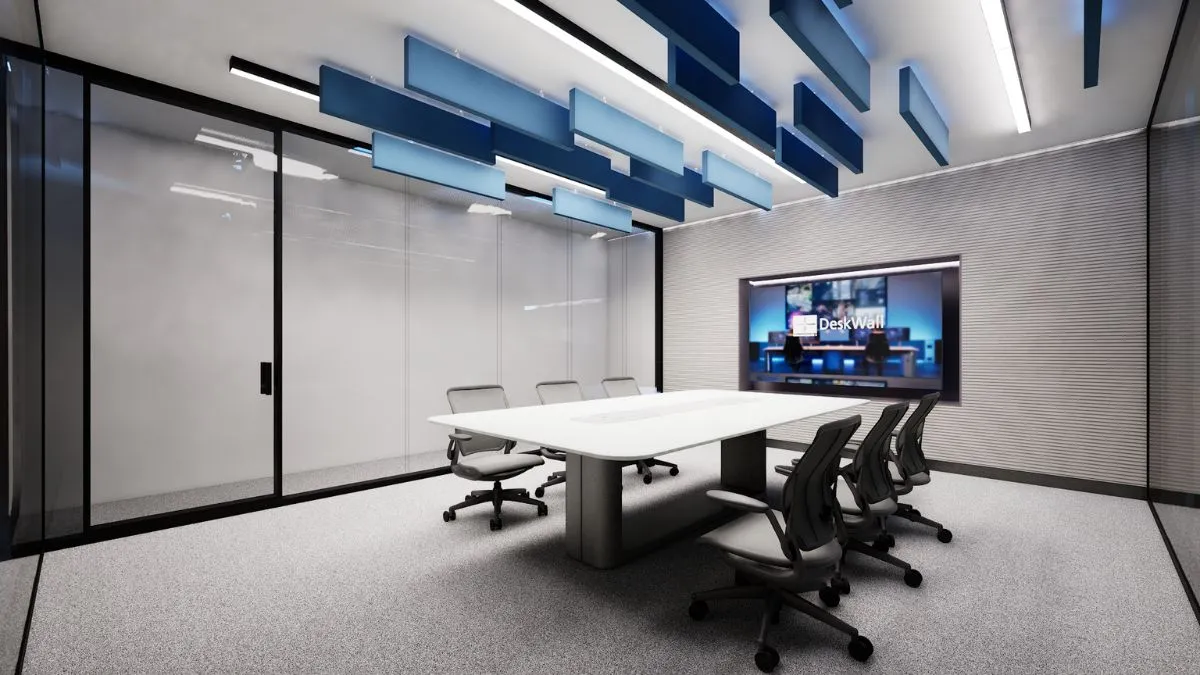
As an optimal scenario, sound-absorbing coatings are proposed on walls, floors and ceilings. Maintaining the carpet covering on the floor, a viewing front with an exterior finish of grooved paneling is proposed; In addition, PET baffles are distributed on the ceiling, which in turn act as sound wave diffusers, reducing echoes and improving sound clarity.
- Floor: Carpet.
- Ceiling: PYL recordable false ceiling (80%) and PET baffles (20%).
- Walls: Glass (80%) and slotted paneling (20%).
In this way, we obtain a low final reverberation time of 0.51s, exceeding the minimum requirements and considerably improving the comfort and acoustic qualities of the space.
Conclusions
At GESAB we are convinced that acoustic comfort is vital for the operation and efficiency of control rooms and critical environments. The correct application of acoustic solutions to meet the optimal parameters in each of these spaces not only improves sound quality, but also contributes to creating a healthier work environment.
Investing in acoustic comfort is much more than addressing a technical aspect: it is betting on the comprehensive well-being of operators and quality in making critical decisions. This allows us to be a guarantee of the future for our clients, ensuring spaces designed for operational success, well-being and productivity.